
Covid-19, US yields, dollar to weigh on equity flows in the near term.

Although such alerts are not compulsory for the banks, this may become the norm now if payments are missed even for a day.

New-generation private sector banks such as ICICI, HDFC, Axis, Kotak etcetera owe their existence to the recommendations of the first Narasimham Committee.

The sudden movement of the rupee - post the monetary policy - is not a reason to panic, said currency dealers. According to them, a correction was overdue for the rupee that remained the best performing currency in the region for well over a month. The rupee closed at 74.72 a dollar on Friday from its previous close of 74.60. It had dropped 1.52 per cent against the dollar on April 7 after the Reserve Bank of India (RBI) announced its monetary policy, committing to buy Rs 1 trillion of bonds in the June quarter. A weak rupee goes well with the export narrative of the government, and is consistent with the RBI's intervention strategy that prevented an appreciation.

'There are obvious concerns regarding revenue leakage which is understandable, but there are also concerns about whether or not well accepted, judicially tested, fair and proper procedures are being followed during such arrests.'

However, the department has not changed ITRs significantly, considering Covid-19 crisis.

For development finance institution to succeed now, the government must stand like a rock behind it and be patient.

If the data breach is found to be genuine, and if the company is found guilty on the grounds of dereliction of duty, or misleading the general public and the RBI about the data breach, actions taken against it will be severe, the person quoted above said.
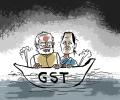
CAG recommended fixing a definite time frame for rolling out simplified GST return forms.

Bank of America (BofA) Securities expects India to be the third-largest economy in the world by 2031. The economic rise could become a reality by 2028, but the Covid pandemic delayed the pace, BofA Securities economists Indranil Sen Gupta and Aastha Gudwani wrote in a report.

In the state of the economy report, the RBI said bond vigilantes could undermine the recovery, unsettle financial markets, and trigger capital outflows from emerging markets.

The Cabinet has cleared a Bill to set up a government-owned development finance institution (DFI) with initial paid-up capital of Rs 20,000 crore so that it can leverage around Rs 3 trillion from the markets in a few years to provide long-term funds to infrastructure projects as well as for development needs of the country. To put it in perspective, Rs 3 trillion constitutes slightly less than 3 per cent of the Rs 111 trillion to be spent on over 7,000 projects in the National Infrastructure Pipeline from 2019-20 to 2024-25. Besides, the government will give Rs 5,000 crore as grant to the institution, Finance Minister Nirmala Sitharaman on Tuesday told the media after the Cabinet meeting.

In India, it is not easy to fight it out with the large banks which are nimble-footed and technology-savvy and are continuously innovating on the retail turf with newer products for customer acquisition.

The apex court has settled the long-pending dispute between companies such as Samsung, IBM, HP & others and the tax department.

Taking lessons from that, I would think seamless digital payments is something you have to clearly have a roadmap for, the FM said.

The bond market is not in a mood to reason with the Reserve Bank of India (RBI) on keeping yields low. The 10-year bond yields continued to rise for the fourth straight session to close at 6.202 per cent from its previous close of 6.135 per cent. The yield was at 6 per cent a week ago. The RBI wants the yields to remain at 6 per cent, but bond dealers say the central bank will have to step up its bond-buying programme.
The central bank bought the 10-year bonds at 50 paise above the prevailing rate, and brought down the yields from 6.08 per cent to 6 per cent mark.
However, the RBI is still not in a mood to issue an OMO calendar, which was the expectation in some sections of the market.

Working hours cannot go beyond 48. Those who give a four-day week will have to provide three consecutive holidays after that.

'Pump prices of petrol and diesel have reached historical highs. An unwinding of taxes on petroleum products by both the Centre and the states could ease the cost-push pressures,' the Monetary Policy Committee (MPC) has said.
 © 2026 Rediff.com - Investor Information - Advertise with us - Disclaimer - Privacy Policy - Sitemap - Feedback - About us - Terms of use - Grievances